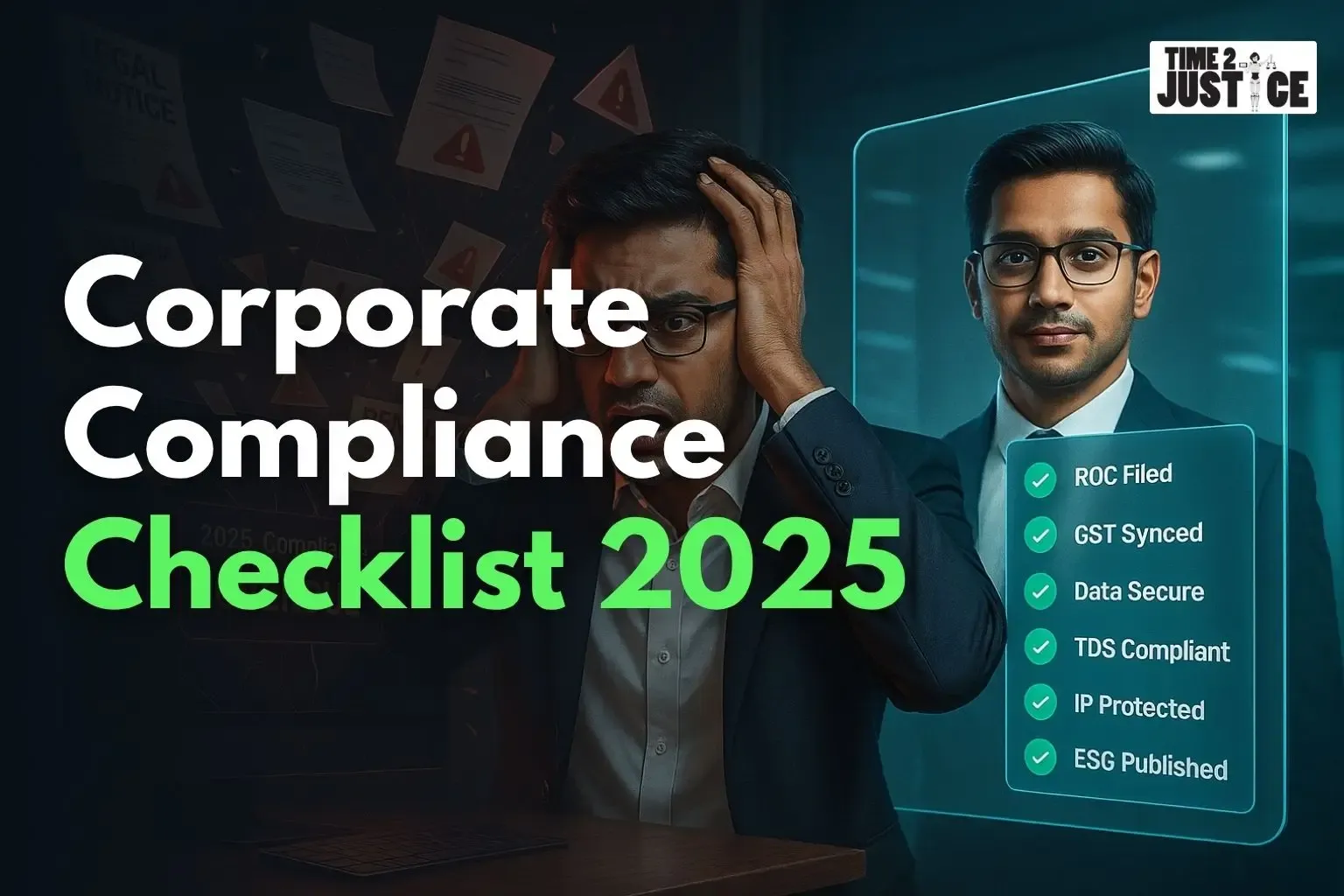
AI strategist transforming legal intelligence in India.
Introduction: Why 2025 Is a Crucial Year for Corporate Compliance in India
As India continues to emerge as a global economic hub, regulatory oversight has tightened across industries. Whether you're a startup founder, SME owner, or corporate executive, corporate compliance in India in 2025 is no longer optional it's critical for credibility, growth, and legal safety.
Failing to meet statutory obligations can lead to financial penalties, deregistration, loss of business licenses, and reputational damage. To help businesses stay ahead, we've created a comprehensive Corporate Compliance Checklist for 2025, tailored to Indian laws and updated with the latest reforms.
Corporate Compliance India 2025: Your Ultimate Checklist
1. Company Law Updates & ROC Filings (MCA Compliance)
Under the Companies Act, 2013, every registered company must file essential reports with the Registrar of Companies (ROC) to maintain good standing:
Annual Return (Form MGT-7): Summarizes the company’s shareholding structure, financials, and compliance status.
Financial Statements (Form AOC-4): Must be filed within 30 days of the AGM; includes the balance sheet, P&L, and board report.
Director KYC (Form DIR-3 KYC): Annual KYC for all directors with a DIN, failure results in deactivation.
Auditor Appointment/Resignation (Form ADT-1/ADT-3): Mandatory within 15 days of the AGM or auditor change.
Board Resolutions (Form MGT-14): For select resolutions like change in company name, borrowing powers, etc.
Updates for 2025: The MCA V3 portal simplifies e-filing with improved user experience and AI-assisted form validation. E-adjudication mechanisms now automate penalty imposition for late or incorrect filings.
Action Tip: Maintain a digital compliance calendar to track statutory deadlines. Non-compliance with ROC filings can lead to cumulative penalties and director disqualification.
2. Goods & Services Tax (GST) Compliance
GST compliance ensures uninterrupted operations and tax credit claims:
GSTR-1: Monthly or quarterly details of outward supplies (sales).
GSTR-3B: Monthly summary return including ITC and tax payment.
ITC Reconciliation: Match purchase records with GSTR-2B to claim input credit.
About the Author
Prateek Agrawal
Co-founder, Time2Justice.ai | AI Strategy & Legal-Tech Architect
Prateek Agrawal is a computer engineer with a Master’s degree from Texas and the Co-founder of Time2Justice.ai, an AI-powered legal-tech platform focused on transforming how individuals and businesses access legal intelligence in India. He has also co-founded Ivy Professional School, a top-ranked AI upskilling and consulting platform for enterprises.
He works at the intersection of artificial intelligence, data systems, and legal workflows, building scalable AI solutions for legal research, dispute profiling, background verification, and organizational risk assessment.
Prateek writes about AI in law, digital justice infrastructure, legal data intelligence, and the future of AI-assisted decision-making. His goal is to make complex legal processes more transparent, accessible, and data-driven for citizens, businesses, and institutions.